
Franklin County Criminal Docket Searches
Start with court level. The County Clerk court-record page handles County Court criminal files. But only Class A and Class B misdemeanors. Felonies sit with the District Clerk. Felony settings for a given date live in the separate District Court Dockets archive. Neither local docket archive lets you search by party name or cause number. Browsing is the only route.
Before you dig in, collect a few facts. You will want the cause number, the offense level, the rough year, and the exact document you need. A defendant name paired with an offense date can track down a misdemeanor file. Share a full birth date only through the official clerk channel.
- Decide whether the case is a County Court misdemeanor or a District Court felony.
- Browse the matching official year and date archive when the setting date is known.
- Try re:SearchTX with the cause number and a Franklin location filter, while expecting limited criminal coverage.
- Contact the County Clerk for Class A/B records or the District Clerk for felony records.
- Ask for the signed judgment or order, with certification if needed for formal use.
Franklin Criminal Docket PDF Indexes
Think of the two local archive pages as shelves sorted by year and date. The County Court docket shelf runs from 2018 through 2026. In older years the sections split into County Court Docket and Arraignment Docket. The district side names each PDF by date and type. Types include Felony Docket, Felony Arraignment Docket, PTR Docket, WHC Docket, Bench Trial, Court Notice, and Order of Assignment.
A label helps you pick the right PDF. It says nothing about any person, though. Files get replaced. The county archive posts cancellations when settings change. Save the source URL and date whenever you rely on a schedule. Then confirm the hearing with the clerk. The official District Court Dockets page lays out this date-led structure.
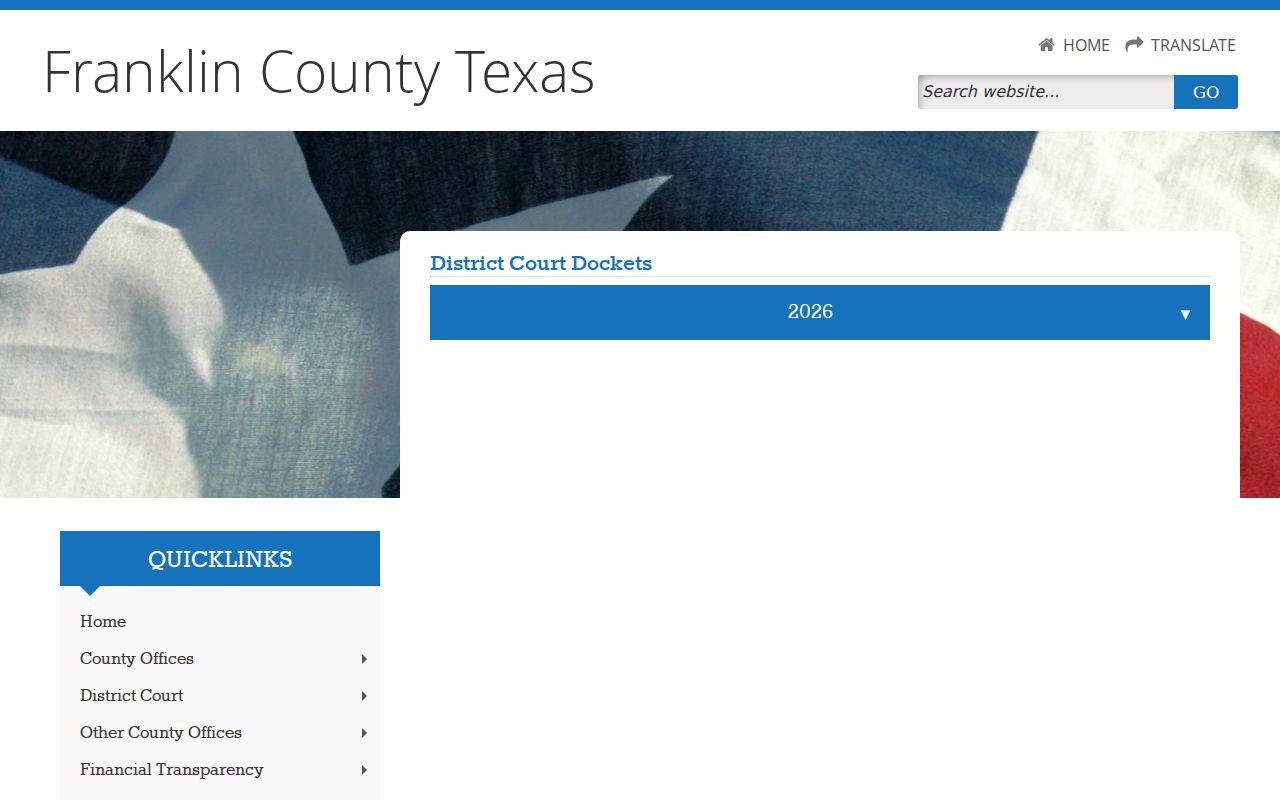
The index works well for pulling a posted Franklin County criminal docket by date. For a case-specific filing or a certified copy, the District Clerk is the office to call.
Criminal Dockets: What They Show
A County Court sample lays out the field families below, without keeping party names. Those fields frame the schedule and the next court event. They cannot stand in for a signed judgment. Nor an indictment, a bond order, or a final disposition. The official cause number remains the safest locator. No single local number format applies across the board.
| Cause number | The court's case identifier and best search key. |
|---|---|
| Style or defendant | The caption; a name match alone does not confirm identity. |
| Charge and bond | Alleged offense, bond details, and possible TRN tracking verification. |
| Counsel | State attorney and defense attorney fields when shown. |
| Setting or action | Reset, pre-trial, plea, arraignment, sentencing, or check status. |
An arrest or charge on a Franklin County criminal docket is only an allegation. It is not proof of guilt. To confirm the true outcome, get the signed final document from the clerk.
Two Franklin Criminal Docket Clerks
Franklin County splits its criminal docket records by offense level. That split trips people up. Misdemeanor files of Class A and Class B rank sit with the County Clerk in County Court. The District Clerk keeps every felony filing instead. Send a felony request to the wrong office, or a misdemeanor request to the District Clerk. A "not found" answer will likely come back. A quick check could have avoided it.
| Record | Custodian | Access path |
|---|---|---|
| Class A/B misdemeanor | County Clerk | Records room, mail, or email form |
| Felony | District Clerk | District archive, clerk contact, or state access |
| Fine-only case | Justice or city court | Issuing court clerk and forms |
You can reach the County Clerk at 200 N Kaufman Street in Mount Vernon. The phone there is 903-537-8357. The District Clerk sits at Courthouse Annex West, 204 Texas Highway 37, phone 903-537-8337. Call before you go. Counter hours vary. A courthouse elevator notice may matter if stairs are a problem for you.
Criminal Case Stages on the Docket
A Franklin County criminal court docket walks a case from first setting to final action. Arraignment comes early as the formal opening stage. Later pre-trial settings cover readiness, motions, discovery, or a negotiated deal. A reset just moves the case to a new date. It does not dismiss anything. From there, the labels change. Plea, trial, sentencing, and check-status entries each mark one distinct event in the court record.
Docket flow: Filing › Arraignment › Pretrial › Plea or Trial › Disposition › Sentencing
Franklin County felony rules carry their own exceptions. A waiver of arraignment is not available for felony DWI unless counsel proves the stated ignition-interlock condition. Assaultive offenses on the list follow a separate agreed-bond-condition rule, so the docket entry and the signed order control what applies in each case.
Franklin Criminal Docket Requests
Start on the County Clerk's request form. Select Criminal. Then list the defendant's name. Add the requested birth date, the offense and its date, the cause number if known, and the exact documents you want. Delivery runs three ways: U.S. mail, non-certified email, or hold-for-pickup. The clerk takes no phone requests. Allow seven to ten business days for a response.
The fees are simple. A search costs $5 per name per case type. Copies run $1 per page, and certification adds $5 per document. Payment instructions follow once the clerk receives your request. Email requests require online payment and a copy of your driver license. Send that identification only through the official channel. Confirm the fees before you pay anything.
In person works too. The County Clerk keeps a records room open for public searching. Bring the cause number and a short document list. Then ask the staff what terminals, scanners, or printing help they provide on the criminal docket. If you mail the form, follow its current payment directions. Avoid sending cash unless the office expressly says to. Keep your copy of the form, the receipt, the response, and the official source link in one place. A reply of no record found is not the end. Ask whether the case sits in District Court, Justice Court, or a city court. Do that before paying for another broad name search on the court docket.
Franklin County Criminal Docket Courts
Misdemeanor Class A and B cases in Franklin County sit in the constitutional County Court, with the County Clerk keeping those records. Felony cases belong to the 8th and 62nd District Courts. Assignments shift by matter, so a current docket, a written order, or a call to the right clerk beats any general court list. Justice Court handles its own matters. The municipal courts in Mount Vernon and Winnsboro keep separate dockets for fine-only and city cases. Appeals create a second set of records. Franklin County falls inside the Sixth Court of Appeals service area, and that appellate docket search runs apart from the trial court archive. Federal cases go to the Eastern District of Texas through PACER rather than to any county clerk.
Franklin Criminal Docket Portal Limits
The re:SearchTX portal asks you to sign in with eFileTexas credentials or register first. Its menu offers Cases, Filings, Text, and Hearings. Filters cover Location, Case Category, and Case Type. A cause number plus a Franklin location works far better than a broad name search. When your access level and the data allow, you can open the case, filing, or hearing detail pages. Coverage is the real caution here. The state reporting source describes its public document collection as excluding criminal case records. So an image may be missing even when the clerk holds the paper. eFileTexas is a filing system, not open public access. An empty portal hit never proves a case does not exist. Take the question to the correct clerk instead. The local date PDFs serve a different purpose. They can confirm that a felony, arraignment, PTR, or other docket was posted on a given day, but they cannot run a statewide party search, and they may lack the filing that answers an outcome question. The statewide portal spans participating courts. Its results still turn on integration, access role, and record type. Use the date archive for a posted schedule. Use re:SearchTX as a possible electronic locator. And use the clerk for authoritative copies. That three-part approach cuts down the false conclusions that come from expecting one system to do every job.
Access Rules for Criminal Dockets
Texas Rule of Judicial Administration 12 generally opens judicial records to inspection during regular business hours. An exception may apply. Even within one case, though, a docket entry, a filed image, and a completed form can carry different status. Rules, statutes, and orders may still shield juvenile records, sealed matters, expunction materials, and personal identifiers. Check first. Not everything in the court file is public.
Key access rules:
Texas Rule of Judicial Administration 12 sets the judicial-record inspection framework and exceptions.
Texas Family Code chapter 58 supplies the juvenile-record confidentiality framework.
Texas Government Code chapter 411 addresses criminal-history and nondisclosure provisions.
Ask first: when an item is missing, find out whether it is sealed, non-public, simply not online, or outside that portal. Never republish birth dates, license numbers, addresses, or juvenile identities pulled from a court record.
Franklin Docket Relief Orders
Expunction and nondisclosure are formal court processes, not routine requests to erase a result. The District Clerk links coordination material for expunctions. The County Clerk fee schedule lists a nondisclosure fee after disposition plus a separate petition filing amount. Eligibility, service needs, and the effect of an order all stay case-specific. Systems update on their own schedules once an order signs. Request the entered order itself. Ask which agencies received it. A lawyer can address eligibility. A public docket alone never shows that someone qualifies for relief. That point also explains why the record custodian matters so much. A date-indexed PDF can stay useful as a historical schedule. That holds even when a court order changes later access to the case file. The statewide portal, the County Clerk system, and District Clerk records may each refresh on different cycles. Rely on the most recent official response for current status. Skip reposting an older screen capture. When a clerk restricts access, ask for the rule, statute, or order that controls. Then follow the stated review process. Do not feed the same private data to several portals.